China Top Cockroach Bait Manufacturers for Global Buyers

Global buyers need more than a low quotation when comparing China’s cockroach bait manufacturers. Product consistency, clear technical documentation, and dependable communication matter just as much. A bait may look convincing in a sample jar. The real test is whether its formulation, packaging, and performance remain consistent across production batches.

Dr. Michael F. Potter, an urban entomologist known for his work on pest management, offers a useful principle, paraphrased here: “Bait works best as part of a wider control plan.” That perspective matters when evaluating suppliers. Buyers should ask about formulation options, quality-control procedures, shelf-life testing, packaging specifications, and support for destination-market requirements. They should also review product labels and safety documentation before making procurement decisions. Details matter.

This guide introduces considerations for finding and assessing cockroach bait manufacturers in China. It focuses on supplier capability, product information, communication, and practical questions to raise during evaluation. A polished catalogue is helpful, but it cannot answer every question. Requesting current documents and discussing intended use can reveal gaps early. Not always. Supplier claims may still need careful verification, and one product will not suit every setting. That uncertainty deserves attention. The aim is not to name a universal winner, but to help global buyers compare options with clearer criteria and make more informed decisions.

China Top Cockroach Bait Manufacturers for Global Buyers

Understanding China’s Cockroach Bait Manufacturing Industry

China’s cockroach-bait manufacturing sits within a much larger pesticide sector, but the figures need careful reading. The National Bureau of Statistics’ 2023 industrial output data recorded about 2.676 million tonnes of chemical pesticide technical material. That is not cockroach-bait output; it covers many pest-control products and active-ingredient forms.

This distinction matters. Buyers should assess bait-specific formulation capability, not infer it from national tonnage.

UN Comtrade’s HS 3808.91 category covers insecticide preparations, not cockroach bait alone, so trade totals cannot verify bait-specific production capacity. Inside a factory, reliability depends on repeatable mixing, measured fill weight, leak-resistant packaging, batch records, and stability testing under heat and humidity. A practical supplier review should request test methods and batch-level results, not just attractive sample tubes.

A uniform gel bead matters. Yet shelf-life tests may not represent a humid warehouse or long transit. That gap deserves scrutiny.

China has substantial chemical-pesticide manufacturing scale, but public statistics do not isolate cockroach-bait production lines. The comparison is imperfect; buyers still need product-specific evidence when evaluating manufacturers.

Types of Cockroach Baits and Their Applications

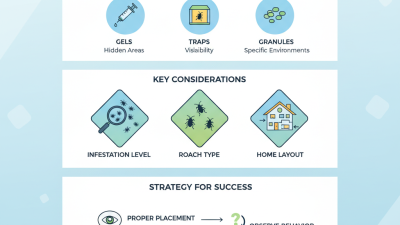
Cockroach baits come in several forms, and each suits a different setting. Gel bait works well in narrow cracks, cabinet hinges, and gaps behind appliances. Apply small placements near signs of activity, such as droppings or shed skins, rather than across open counters. Placement beats quantity. Keep treated areas away from food and follow the product label.

Bait stations contain bait inside a covered housing. They can be useful along walls, beneath sinks, or in other spots where loose gel might be disturbed by children, pets, or cleaning. Their rigid shape can make tight crevices harder to reach, though. Check stations regularly and replace them as directed; an untouched station may mean the placement needs reconsidering.

Granular baits are generally suited to suitable outdoor areas, such as sheltered spaces near building foundations, only when the label allows that use. Moisture can reduce their usefulness, so exposed, wet locations are poor choices. Clean crumbs and grease, fix leaks, and avoid spraying insecticide near bait placements unless the label specifically permits it. Bait alone may not solve an infestation. Monitoring matters. A simple activity log can reveal whether roaches are shifting to another hiding place, but inspection is easy to neglect.

How to Evaluate Chinese Bait Manufacturers

Evaluating a Chinese cockroach bait manufacturer starts with evidence, not polished catalog photos. Request specifications for the bait matrix, active ingredient, target species, shelf life, and storage conditions. Ask for recent batch test reports and a sample from the same production line used for export. Check whether the packaging clearly shows batch numbers and storage instructions. Small details matter.

Review the manufacturer’s quality controls, including raw-material checks, production records, and procedures for handling customer complaints. Ask whether independent testing supports efficacy and stability claims; request the methods and test conditions, not just a sales summary. Verify that safety documents and product registrations match the destination market, since requirements differ by country. A factory audit can reveal how samples are labeled and stored. If an on-site visit is not practical, request a live video walkthrough and dated records. A sample can perform well while later batches vary. One report is not enough. Compare several production lots, clarify how defects are resolved, and keep written specifications with the purchase agreement. I would still treat unusually strong claims cautiously.

China Top Cockroach Bait Manufacturers for Global Buyers - How to Evaluate Chinese Bait Manufacturers

Evaluation Dimension Evidence to Request How to Evaluate Suggested Weight
Regulatory readiness Product registration or authorization for the destination market; approved label; current Safety Data Sheet (SDS); active-ingredient and formulation details. Confirm that the product and its intended claims are authorized in each target market. For example, pesticide requirements differ between the U.S. EPA system and the EU Biocidal Products Regulation (BPR). Verify documents with the relevant regulator or qualified local adviser. 20%
Efficacy evidence Test reports identifying cockroach species, bait formulation, test conditions, controls, sample size, observation period, and measured outcomes. Prefer reproducible, product-specific studies over general claims. Check that the tested species and conditions are relevant to the intended market and that conclusions match the approved label. An ISO/IEC 17025-accredited laboratory can add confidence when the relevant test is within its accredited scope. 20%
Quality management Quality-management certificate, scope and validity; inspection procedures; nonconformance and corrective-action records; recent audit findings, where available. Check certificate validity and whether its scope covers the relevant manufacturing site and activities. ISO 9001 certification may indicate a documented quality-management system, but it does not by itself prove that a specific bait product meets its specifications. 15%
Batch testing and traceability Representative batch Certificate of Analysis (COA); test methods and acceptance limits; batch coding; retention-sample and complaint-handling procedures. Match the COA to the product specification and batch number. Confirm that records can trace incoming materials through production to finished goods, and ask how out-of-specification results are investigated and documented. 15%
Formulation and product consistency Product specification covering active-ingredient content, bait form, appearance, and relevant physical or chemical tests; change-control policy. Compare the specification, sample, COA, and approved registration information. Ask how formula, raw-material, or process changes are controlled and how buyers are notified before changes that could affect compliance or performance. 10%
Packaging and shelf-life support Packaging specifications; compatibility or stability data; storage instructions; substantiation for the stated shelf life; label and artwork proof. Confirm that packaging protects the bait under the intended storage and transport conditions and complies with destination-market labeling rules. Check that the shelf-life claim is supported by relevant data rather than an unsupported estimate. 10%
Export documentation Commercial invoice, packing list, certificate of origin where applicable, SDS, transport information, and any destination-specific permits or declarations. Ask the supplier to confirm which documents it can provide for the selected product and shipment. Independently verify import, customs, dangerous-goods, and pesticide requirements for the destination and transport route. 5%
Commercial and communication reliability Written quotation, production and shipment terms, sample process, named contact, complaint-response process, and references that can be checked with permission. Compare offers on the same product specification and delivery terms. Assess response clarity, document consistency, and willingness to answer technical and compliance questions in writing. Confirm lead times and order conditions in the contract. 5%
Total suggested evaluation weight 100%

Note: This is a buyer evaluation framework, not a ranking or certification of any manufacturer. Requirements vary by destination market, product, and intended use; verify applicable regulations and claims before purchase.

Quality Standards and Export Compliance

For global buyers, product quality starts with controlled ingredients, stable bait texture, and verified packaging. Ask manufacturers for batch-specific certificates of analysis, test methods, and shelf-life data. Check that samples match production specifications, including bait weight, moisture control, and container seals. A neat certificate folder is reassuring, but it does not prove every shipment is consistent. Independent testing can help confirm key claims.

Tips: Request recent test records. Compare sample and bulk packaging. Keep batch numbers traceable.

Export compliance depends on the destination market and product classification. Confirm local registration, ingredient limits, label language, hazard statements, and import documents with the importer or relevant authorities before placing an order. Requirements can change, so avoid relying on an old label or a supplier’s general assurance. Review safety data sheets and shipping documents for accuracy, and agree in writing who will prepare each file. Small errors matter: a missing lot code or mismatched product description can delay customs clearance. I would also allow time for label review; it is easy to underestimate.

Sourcing and Importing Cockroach Baits from China

Sourcing cockroach baits from China requires more than comparing unit prices. Grand View Research estimated the global pest control market at USD 24.6 billion in 2023, with continued growth projected through 2030. This broader market figure is not a forecast for cockroach baits, but it signals why buyers should verify product fit rather than rely on demand claims. Ask manufacturers for the active ingredient, bait formulation, target species, batch number, shelf life, and storage conditions. Request recent quality documents and a sample for evaluation.

Check destination-market requirements before placing an order. Product registration, labeling, language, and import documentation can vary by country. The FAO/WHO International Code of Conduct on Pesticide Management offers a useful reference for responsible pesticide management, but it does not replace local rules. Confirm that labels and safety data sheets match the shipped formulation. Then review carton strength, inner packaging, and temperature exposure during transit. Small details matter.

A low quote can hide costs in testing, relabeling, or delayed clearance. A neat catalogue can still conceal an inconsistent batch. Compare samples with agreed specifications, and put acceptance criteria in the purchase contract. One limitation is easy to overlook: a strong factory audit cannot prove every shipment performs equally well. Keep batch records and inspect incoming goods.

chevron-right