
China Best 4x6 Thermal Label Suppliers?
Choosing a 4x6 Thermal Label supplier is not just a price comparison. The right stock must feed cleanly, print sharply, and stay attached through handling. A faded barcode or curled corner can slow packing at the worst moment. Small details matter.
This guide compares suppliers by the factors buyers can verify: label dimensions, roll configuration, adhesive options, printer compatibility, material consistency, and sample availability. Direct thermal labels suit many short-term shipping workflows, while thermal transfer labels use a ribbon and may fit different durability needs. Confirm the printer model and core size before ordering. Ask for samples, then test them on your own equipment. A smooth sample on a desk proves little.
A useful sourcing principle is: “Match the label to the printer, package, and journey—not just the quoted price.” This is an original editorial statement, not a verified quotation from a named industry expert; no sourced expert name or quote was provided. That distinction matters. Supplier claims deserve checking against samples, specifications, and clear purchasing terms.
The suppliers covered here serve different needs. Some prioritize bulk pricing. Others offer more material choices or responsive support. The comparison aims to make those trade-offs visible, not to declare one universal winner. There is no perfect label for every operation. Even a careful shortlist can miss a detail, so test before committing to a large order.
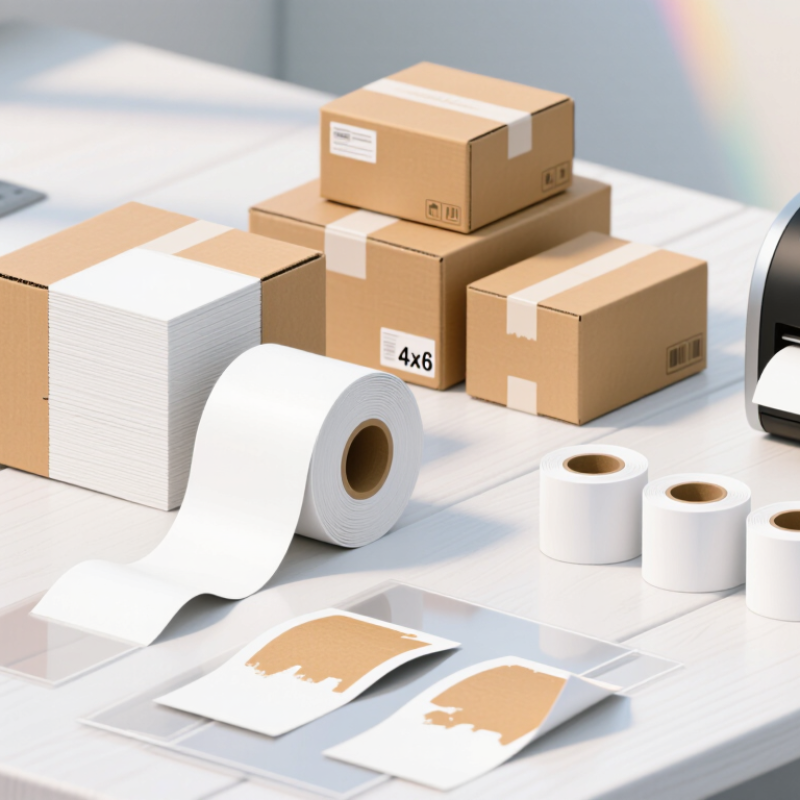
What Defines a 4×6 Thermal Label and Its Common Uses
A 4×6 thermal label measures four inches by six inches, or about 102 by 152 millimeters. Its broad face leaves room for a destination address, a large barcode, and routing details. The label stock has a heat-sensitive coating, so a thermal printer can form text without ink. No ink cartridges. Some labels use direct thermal stock; others need a ribbon, and the two are not interchangeable.
These labels are common on parcel shipments, warehouse cartons, and return packages. Their size suits automated scanning: a clear barcode can remain readable even when a box has several handling marks.
The 2024 Pitney Bowes Parcel Shipping Index reported 21.7 billion U.S. parcels in 2023, underscoring the scale of parcel handling where consistent, scannable labels matter. A report’s parcel count does not measure label demand directly, though.
Stock choice still matters. Direct thermal labels can darken with heat, sunlight, or friction, so they may be less suitable for long storage. Thermal-transfer labels generally use a ribbon and can better suit durable identification needs. Adhesive performance also varies: a label that sticks to clean corrugated cardboard may lift from a dusty or cold carton. Small detail, big headache. Check printer compatibility, barcode contrast, and the actual surface before ordering in bulk.
How China’s Thermal Label Supply Market Is Organized
China Best 4x6 Thermal Label Suppliers?
China’s thermal-label supply market is organized in layers. Paper and film producers supply facestock, while coating plants add heat-sensitive layers. Converters then cut, slit, and pack rolls for distributors or direct export. For 4x6 labels, buyers often compare core size, roll count, adhesive, and printer compatibility—not just price. Small differences matter. A label that curls in a warm warehouse can slow packing lines.
Demand is supported by China’s large online retail sector. The National Bureau of Statistics reported online retail sales of 15.43 trillion yuan in 2023, up 11 percent year over year. That figure is not a label-sales estimate, but it helps explain steady demand from shipping and fulfillment operations. Suppliers may specialize in economy direct-thermal stock, durable thermal-transfer materials, or custom converting. Their catalogs can look similar, yet coating consistency and roll winding vary. Samples are essential.
Tips: Ask for a current technical data sheet and test rolls on your own printer. Check barcode contrast after exposure to heat, friction, and light. A supplier’s stated shelf life is useful, but storage conditions can change results. Even experienced buyers sometimes overlook this. Compare batch records and inspect several rolls, not just one sample.
Which Criteria Matter When Evaluating Label Suppliers
When comparing suppliers for 4 × 6 thermal labels, start with your printer and workflow, not the quoted price. Ask whether the stock is direct thermal or thermal transfer. The wrong construction may fade, smear, or require ribbon changes. Check the face material, adhesive, liner, roll core, and winding direction against your printer’s specifications. Small details matter. A curling edge can slow packing, even when the print looks sharp. Request samples from the actual production grade. Print barcodes and small text at normal speed, then test labels on the cartons or mailers you use. A neat sample is not enough.
Supplier reliability shows up in repeatability. Compare label dimensions, sensor marks, roll count, and print consistency across batches. Ask about quality checks, material specifications, and how defects are handled. Verify typical lead times and how delays are communicated. Compare usable labels per roll, not only unit price. Price can distract from adhesive performance, especially on textured cartons or cold surfaces. That is an easy evaluation mistake. Even a careful checklist can miss conditions on a busy packing line, so run a small trial before placing a large order. Keep notes on jams, print contrast, and barcode scans; memory is a poor quality-control system.
China Best 4x6 Thermal Label Suppliers? - Which Criteria Matter When Evaluating Label Suppliers
| Evaluation Criterion | Why It Matters | What to Verify | Practical Evaluation Method |
|---|---|---|---|
| Label dimensions | A 4 × 6 in label measures 101.6 × 152.4 mm. Incorrect dimensions or inconsistent cutting can cause feed and alignment problems. | Finished label width and height, dimensional tolerances, and whether measurements refer to the label or its backing paper. | Measure samples from different parts of a roll or pack with a ruler or caliper, then test them in the intended printer. |
| Printing technology | Direct thermal printing uses heat-sensitive label stock and does not require a ribbon. Thermal-transfer printing uses a ribbon and can suit applications needing greater resistance to wear or environmental exposure. | Whether the material is direct thermal or thermal transfer, and whether it matches the intended printer and use. | Print sample labels using the planned printer setup. Check readability and resistance to expected handling, heat, light, and abrasion. |
| Printer compatibility | Printers differ in media handling, sensing, and roll or fan-fold requirements; a label that does not suit the printer may misfeed or print out of position. | Roll core diameter, roll outside diameter, winding direction, gap or mark configuration, and available fan-fold format. | Confirm specifications against the printer manual and run a test using the exact media format and sensor settings. |
| Adhesive performance | Adhesion depends on the label face stock, adhesive, surface, temperature, and application conditions. A label that works on cardboard may not perform the same on plastic or a cold surface. | Adhesive type and intended application conditions, including surface material and temperature range. | Apply samples to the actual packaging surface. Check initial tack and whether edges lift during storage, handling, and transit. |
| Print quality and barcode readability | Clear, consistently printed text and barcodes support reliable scanning. Printer settings and media condition can also affect print quality. | Coating consistency, surface defects, print darkness, and sample performance with the intended printer and barcode workflow. | Print representative shipping labels and scan them with the equipment or system used in the intended workflow. |
| Material and coating consistency | Variation in face stock, coating, or backing can affect feeding, print appearance, and label separation. | Material description, coating type, backing construction, and consistency between sample and production batches. | Compare samples from multiple batches for appearance, feeding, print response, and ease of peeling. |
| Quality control and traceability | Documented checks and batch identification make it easier to investigate defects and compare repeat orders. | Inspection records, lot or batch identification, defect-handling procedures, and the supplier’s stated inspection process. | Request the relevant product specification and batch documentation, then compare incoming goods with the approved sample. |
| Sampling and customization | Samples help confirm compatibility before a larger order. Custom options may include packaging format, roll configuration, or printed content. | Sample availability, minimum order quantity, customization limits, and whether the approved sample can be matched in production. | Agree on a written specification and approve a physical sample before placing a production order. |
| Packaging, transport, and storage | Labels can be affected by moisture, heat, pressure, and handling during storage or transport. | Protective packaging, carton quantities, storage guidance, and the supplier’s process for reporting transit damage. | Inspect delivered cartons and rolls for crushed edges, contamination, moisture, and damage that could affect feeding. |
Note: Roll core size, roll capacity, adhesive performance, and printer compatibility are not universal. Confirm these details against the specific printer, packaging surface, and operating conditions before ordering.
How to Compare Supplier Capabilities, Quality, and Pricing
Comparing 4x6 thermal label suppliers takes more than checking a catalog. Ask what label material they offer, whether it suits direct thermal printing, and which roll core and winding options are available. Confirm the exact label size, roll count, and packaging before requesting a quote. Details matter.
Test samples on the printer you actually use. Check whether barcodes scan cleanly, text stays sharp, and labels feed without curling or leaving adhesive on the printhead. Press a label onto a shipping carton, then check for edge lift after handling. Test them. A sample can look excellent while a later production batch varies, so ask how the supplier checks consistency and handles defects.
Compare pricing on equal terms. A low unit price may exclude custom packaging, setup charges, or freight. Ask about minimum order quantities, production lead times, payment terms, and replacement policies. Request a written quote that lists each cost. For repeat orders, confirm whether material specifications will remain unchanged. I would not overvalue a flawless sample; real production runs can differ, and that uncertainty deserves a direct question.
How to Verify and Select a Suitable Chinese Supplier
China Best 4x6 Thermal Label Suppliers?
How to Verify and Select a Suitable Chinese Supplier
A 4x6 label is not just a paper rectangle. Its coating, adhesive, and roll setup must suit your printer and shipping environment. Confirm the actual size: 4 by 6 inches, or 101.6 by 152.4 millimeters. Ask whether the stock is direct thermal or thermal transfer. Check core diameter, labels per roll, winding direction, gap or mark, and liner type. Get these details in writing. “Standard” is not a useful specification.
Ask for recent production photos or a live factory walkthrough, and clarify whether the supplier makes labels or sources them elsewhere. Request a sample roll and a written quality checklist. Small details matter. Print several labels on your own equipment, then scan the barcodes and check for fading, smudging, or uneven coating. Test adhesion on the cartons you actually use. A sample may look fine on a desk but behave differently in a cold, humid warehouse.
Check the company’s registration details through relevant official business-record channels, and compare the name with the quotation and payment documents. Ask how it tracks batches and handles defects. Test before scaling. A polished sample can still hide production variation; I would inspect the first bulk shipment rather than assume every roll will match. Agree on measurable acceptance criteria, such as label dimensions, print clarity, and acceptable defect rates, before placing a larger order.
